[ONE PIECE] The Original Seven Warlords of the Sea, Revisited
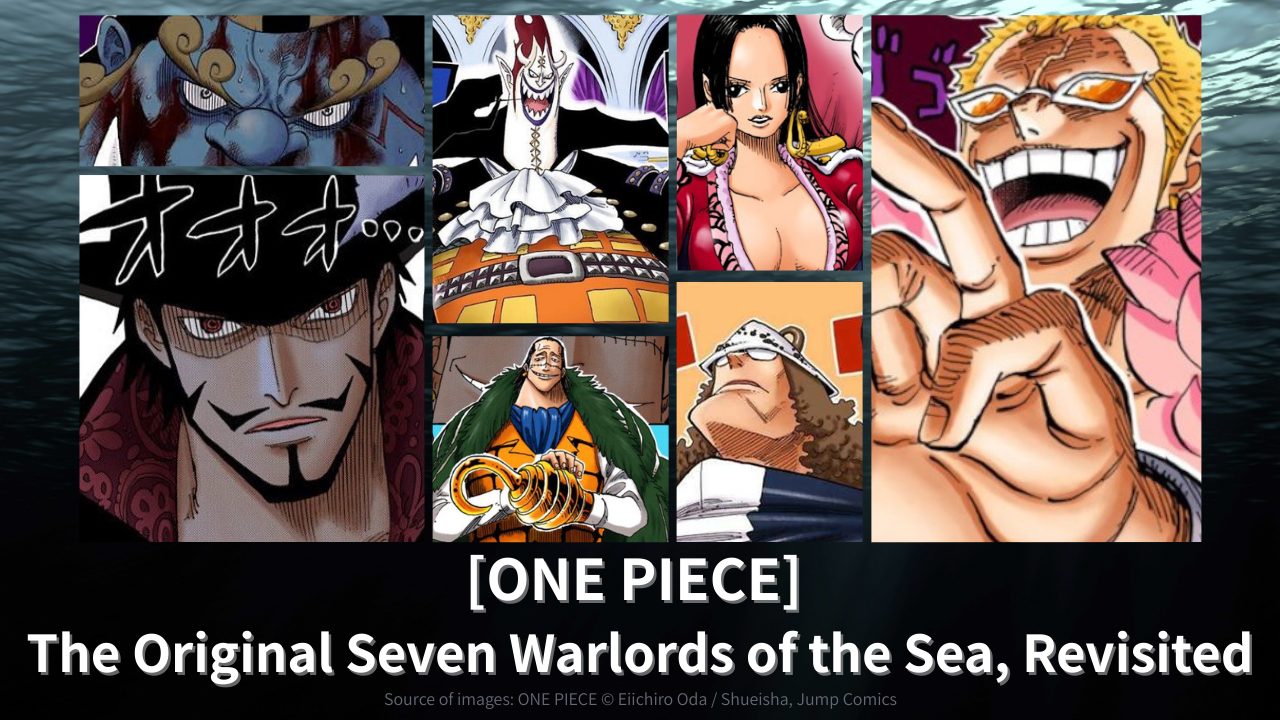
When looking back on the story of ONE PIECE, it becomes clear that the Seven Warlords of the Sea (the Shichibukai), introduced early in the series, were far more than just a group of powerful enemy characters. In many ways, they embodied—far earlier than expected—the core themes that ONE PIECE would continue to explore throughout its long-running narrative.
At the time of their introduction, the Warlords were often perceived simply as “strong,” “terrifying,” or “flashy.” However, as the story progressed and the true structure of the world was revealed—its history, systemic discrimination, and mechanisms of control—their actions and positions began to look very different when reread.
In this article, we reexamine the original Seven Warlords of the Sea from a modern perspective, digging deeper into what they truly represented within the world of ONE PIECE.
What Were the Seven Warlords of the Sea?
The Seven Warlords of the Sea were pirates officially sanctioned by the World Government. In exchange for cooperation, they were granted a certain level of freedom and immunity from prosecution.
At first glance, the system appears to be a rational method for maintaining order. However, arcs such as Alabasta and Dressrosa revealed just how deeply flawed and contradictory this system truly was.
-
Pirates aligned with “justice”
-
Acts such as coups or slave trading being tacitly tolerated
-
A distorted equality where only the strong were protected
The original Warlords can be seen as living embodiments of these contradictions, each personifying a different flaw within the system itself.
Bartholomew Kuma
The Silent Saint Mistaken for a Cruel Enemy
Kuma’s first major appearance at the end of the Thriller Bark arc portrayed him as an incomprehensible and overwhelming force. His ultimatum to Zoro—demanding that he accept all of Luffy’s pain—left readers with a profound sense of fear and injustice.
Yet, when reread today, this moment reveals Kuma’s true nature. While acting as a loyal “dog of the government,” he ultimately spares the Straw Hat crew, testing Zoro’s resolve rather than destroying them. What seemed like cruelty was, in fact, an act of faith in the future.
This becomes even clearer at Sabaody Archipelago. With Kizaru, Sentomaru, and the Pacifista closing in, Kuma scatters the crew across the world. What once felt like total annihilation is now understood as the only reason they survived long enough to face the New World.
The Egghead arc further cements this interpretation, portraying Kuma as a man who knowingly sacrificed his own consciousness for the sake of the future. Among the original Warlords, Kuma may be the one whose true value took the longest to be understood.
Gecko Moria
An Alternate Future for Luffy Who Lost His Dream
In Thriller Bark, Gecko Moria appeared every bit the classic villain: a massive ship, an undead army, and the power to steal shadows. His ideological clash with Luffy—claiming that “you only lose comrades because they’re alive”—once sounded like bitter rationalization.
However, his past defeat at the hands of Kaido reframes these words entirely. Moria was not arrogant; he was broken. After trusting his crew and losing everything, he chose a path where he would never have to rely on others again.
Even Shadow’s Asgard can be seen as a tragic symbol: power that should have been shared, forcibly borne alone. Where Luffy moved forward by trusting his crew, Moria stagnated.
Recent cover stories referencing “Kozuki Moria” at a grave in Wano have reignited theories about his deeper ties to the country, raising anticipation for his potential return.
Crocodile
A Villain Who Is Honest About Being Evil
In the Alabasta arc, Crocodile defined the terror of the Warlords. He utterly crushed Luffy twice, and his cold declaration to Vivi—that ideals are only spoken by those with the strength to back them—stands as one of the series’ harshest early lessons.
Yet from Impel Down through the Paramount War, Crocodile remains remarkably consistent. He bows to no one—not Whitebeard, not the World Government. When he aids Luffy, it is not out of sentiment, but calculation and personal code.
Crocodile is undeniably evil, but he understands, accepts, and wields that evil consciously. That self-awareness is precisely why he is now reevaluated as a villain with unwavering conviction.
With unresolved hints involving Ivankov and his role within Cross Guild alongside Buggy and Mihawk, his future relevance remains highly anticipated.
Boa Hancock
Arrogance Born from Enslavement
Hancock’s introduction in the Amazon Lily arc stunned readers with her beauty and absolute arrogance. Her willingness to petrify anyone who displeased her embodied the Warlords’ unchecked authority.
But the revelation of her past as a slave of the Celestial Dragons—and the brand burned into her back—transformed everything. Her distrust and cruelty were survival mechanisms, not vanity.
Her actions at Marineford, openly protecting Luffy, marked the first time she chose to trust an individual over the world itself. Following the abolition of the Warlord system, Blackbeard’s assault and Rayleigh’s intervention only further emphasize her importance going forward.
Jinbe
A Man Who Carries History, Not Just Strength
Fully introduced in Impel Down, Jinbe consistently presents himself as rational and sincere. His ties to Ace, loyalty to Whitebeard, and position within Fish-Man history elevate him far beyond a mere combatant.
At Marineford, his willingness to sacrifice his life transcended personal loyalty. Later, in the Fish-Man Island arc, his decision to explain Arlong’s past to Luffy—choosing to end the cycle of hatred—stands as one of the series’ most powerful moments.
His affiliations with both the Warlords and Big Mom were not betrayals, but pragmatic choices made to protect his people. Jinbe is a Straw Hat, yes—but first and foremost, he is a bearer of history and ideology.
Dracule Mihawk
The Ceiling of the World
The first Warlord introduced in ONE PIECE, Mihawk made his debut in Baratie by annihilating Don Krieg’s fleet with a single small boat. His duel with Zoro—dominated with nothing more than a dagger—instantly revealed the world’s upper limit.
Since then, Mihawk has rarely fought seriously, yet remains categorically untouchable. To him, the title of Warlord was merely a convenience, a means to preserve freedom.
He seeks neither domination nor revolution—only the endpoint of swordsmanship itself. Mihawk is less an enemy than an ideal, the wall Zoro must one day surpass.
Donquixote Doflamingo
A Monster Born from the World’s Distortions
First appearing in Jaya, Doflamingo’s gleeful manipulation of others made him immediately unsettling. His declaration during the Paramount War—“Justice will prevail? Of course it will. Whoever wins becomes justice!”—remains iconic.
After Dressrosa revealed his past as a fallen Celestial Dragon, his madness reads not as chaos, but cruel consistency. He both loved his family and reveled in the changing era, traits rarely afforded to villains.
Doflamingo is not simply evil; he is the embodiment of a broken system. A living product of the world’s hypocrisy.
Conclusion: The Warlords Who Were Too Early
The deeper the story of ONE PIECE goes, the more meaning the original Seven Warlords gain.
They were never just enemies. They posed questions far ahead of their time:
-
What is freedom?
-
Who defines justice?
-
Is this world worth believing in?
Seen through this lens, the original Seven Warlords were burdened from the very beginning with carrying the future of ONE PIECE on their backs.